Yard Drainage & French Drains
Yard Drainage & French Drains in Richmond, VA
If your yard holds water for days after every rain, it is not going to fix itself. We find where the water is going, and we give it somewhere better to go.
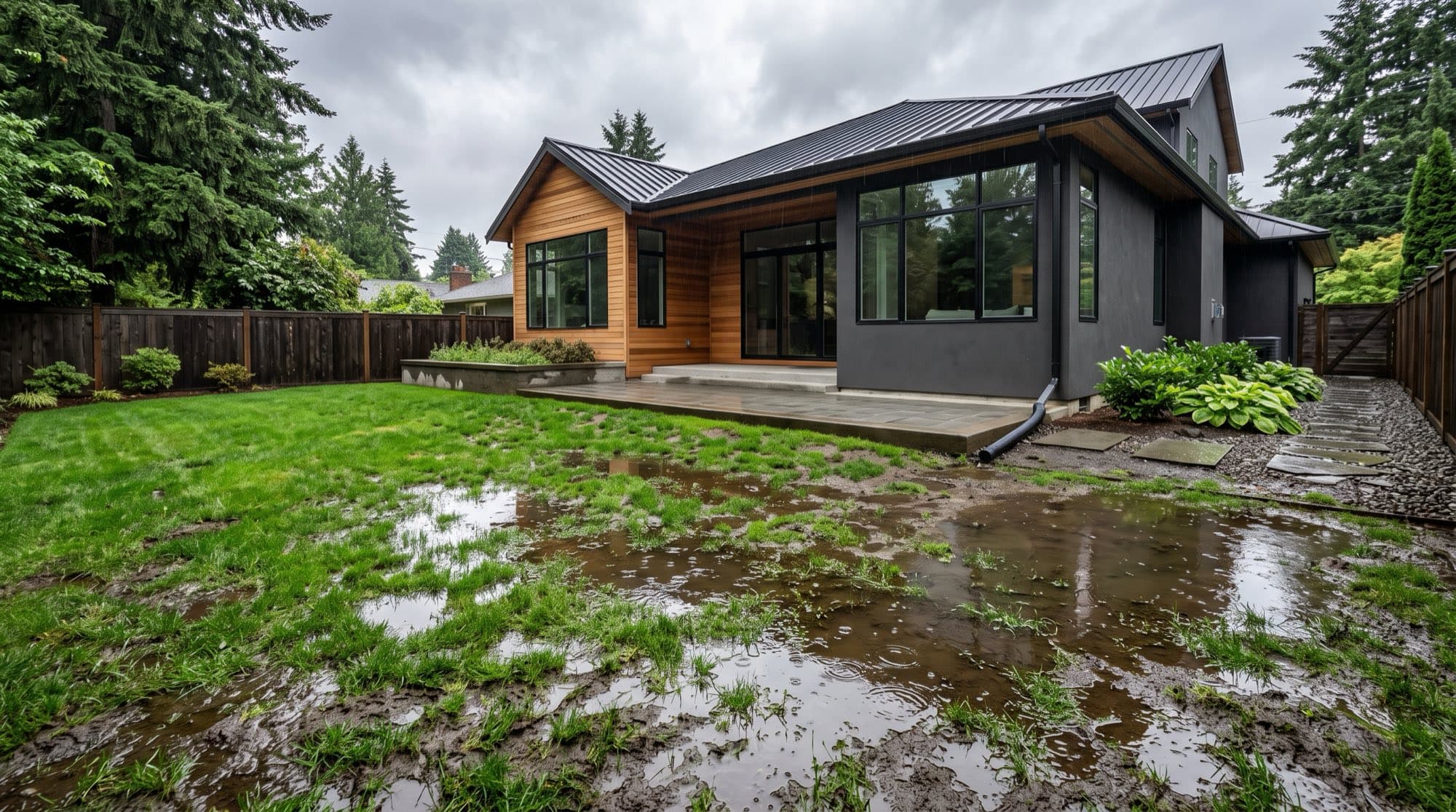
Standing water, soggy patches that never dry out, mud where grass used to be, water pooling against the foundation. These are some of the most common calls we get in the Richmond area, and there is a reason for that. We install French drains, catch basins, channel drains, and buried downspout lines, and we regrade yards that were never shaped to shed water in the first place. Free on-site estimate, clear project price, and a written plan for where the water goes.
Why So Many Richmond Yards Hold Water
Most of Central Virginia sits on heavy clay. Clay does not drain. Water that would soak into sandy soil in twenty minutes will sit on top of clay for two or three days, and every rain after that lands on ground that is already saturated. Add to that the way most subdivisions get built. The lot gets graded for the house and the driveway, not for the backyard. Downspouts dump hundreds of gallons at the corner of the foundation with nowhere to go. Fences, retaining walls, and neighbors' new construction quietly change where the water runs. The result is a yard that was never actually given a path off the property. That is a fixable problem, and it is almost always a grading and drainage problem rather than a soil problem.
What We Install
French drains. A gravel-filled trench with perforated pipe that collects water out of saturated ground and carries it to a lower outlet. This is the workhorse for soggy lawn areas, wet spots that will not dry, and water moving toward a foundation or crawlspace. Catch basins and drain boxes. A grated inlet set at the low point that swallows surface water fast and pipes it away. Best for a spot that actually ponds after a storm. Channel and trench drains. A long, narrow grated drain across a driveway, walkway, patio edge, or garage apron where sheet water crosses hard surfaces. Downspout burial and extensions. Gutters concentrate an enormous amount of water at a few points. Getting that water into solid pipe and moving it well away from the house is often the single cheapest fix on a property, and sometimes it is the whole job. Dry creek beds. A stone swale that carries and slows runoff on the surface. It handles real water volume and looks like landscaping rather than plumbing. Swales and regrading. Reshaping the ground so water is guided off the property before it ever needs a pipe.
Regrading and Erosion Control
Not every drainage problem needs pipe in the ground. A surprising number of them are grading problems, where the yard slopes toward the house instead of away from it, or where a flat area has no fall at all and water simply has nowhere to run. We regrade yards, reshape low spots, cut drainage swales, and establish positive fall away from foundations and outbuildings. With the excavator and skid steer together we can move and shape soil across a full yard in a day or two on most residential properties. We also handle erosion problems: washed-out slopes, gullies forming across a yard, bare soil moving downhill every time it rains, and driveway edges being cut away by runoff. Erosion is almost always a symptom of water moving too fast with nothing to slow it, so the fix is usually a combination of redirecting the water and re-establishing ground cover.
What Yard Drainage Costs in Richmond
Most residential drainage projects in the Richmond area run between $1,500 and $5,000. The range is wide because the work varies so much. What moves the price: how much trench footage is needed, how deep it has to run, whether there is a good gravity outlet or the water has to be carried a long way, how much of the yard needs regrading, whether the ground is full of roots and rock, and how tight the access is for equipment. A buried downspout line and a small catch basin at one bad corner is a small job. A full backyard French drain system with regrading is a larger one. Either way you get a project price in writing before we start, not an hourly rate that grows while you watch. We give free on-site estimates. For drainage in particular we want to see the property, ideally while it is still wet, because where the water actually goes is not something you can guess from a photo.
What We Do Not Do
We would rather tell you this up front than waste your time on an estimate. We work outside the house. We do exterior drainage, grading, and water management on the property. We do not do interior basement waterproofing, crawlspace encapsulation, sump pump installation inside the home, or foundation repair. That said, exterior water is very often the actual cause of an interior problem. If water is pooling against your foundation or running under the house, fixing the grading and the downspouts outside is usually where the solution starts, and it is a lot less expensive than starting inside. If your issue turns out to need an interior specialist, we will tell you that during the estimate. We also do not install septic systems, which require a licensed onsite sewage installer in Virginia, and we do not do work in tidal wetlands or resource protection areas without the proper approvals in place.
How the Process Works
1. Free on-site assessment. We walk the property with you and find where the water is coming from, where it is collecting, and where it can actually be sent. This matters more than any other step, because draining water to a spot that also does not drain solves nothing. 2. A written plan and price. You get a clear description of what we are installing, where it runs, and where it outlets, with a project price up front. 3. Scheduling. Most drainage jobs can be scheduled within about two weeks. 4. Installation. Most residential drainage projects are finished in one to two days. We keep the disturbance tight and put the ground back. 5. Walk-through. We walk the finished work with you and show you exactly where everything runs, so you know what is under your yard.